

If you’re paying for interpreting, you want the meeting to achieve what it needs to achieve without spending more than necessary or compromising on quality.
But when you’re organising a multilingual meeting, there is another decision to make: should you use on-site or remote interpreting?
The interpreting season has started again in September, and I’ve already worked both on-site and remotely. It got me thinking about the advantages and disadvantages of each, particularly from the client’s point of view.
The answer isn’t simply that one is better than the other. It depends very much on the meeting.
On-site interpreting: when being in the room matters
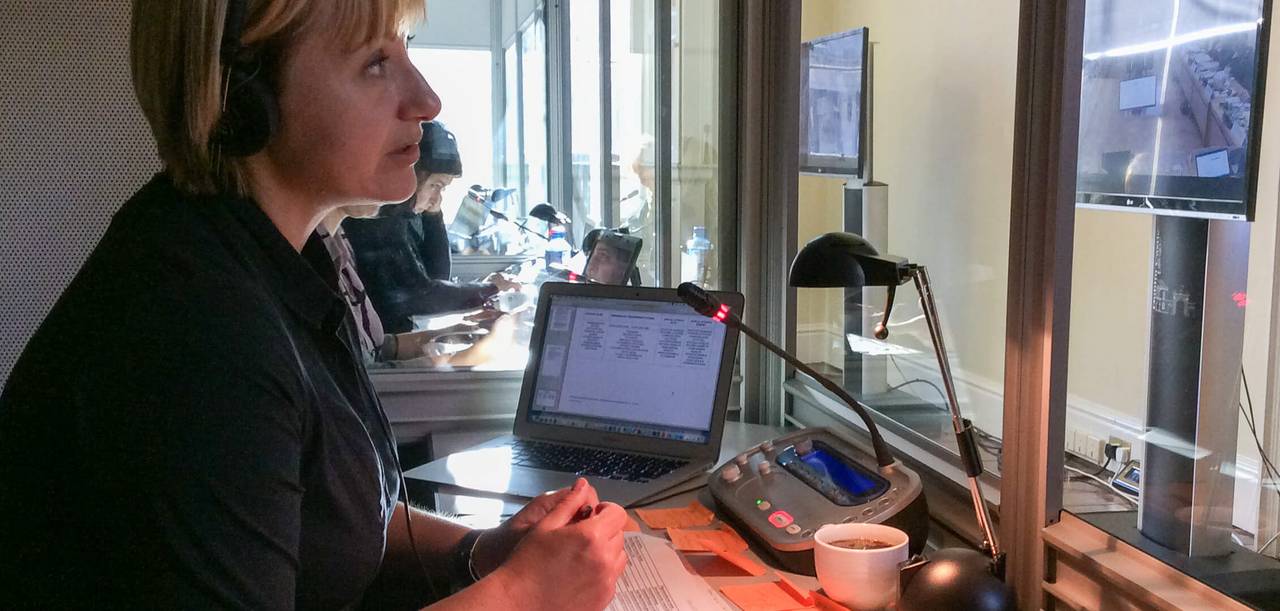
With on-site interpreting, the interpreting team is physically present at the meeting.
That brings something which is difficult to put into a specification or quote: direct human interaction.
Interpreters can build rapport with speakers, pick up the dynamics and nuances of the room and get immediate feedback. They’re also more closely connected to what is happening around the meeting itself.
That can matter when discussions are complex or highly interactive. Perhaps a speaker has used an unfamiliar internal term, someone’s name has been pronounced incorrectly or there is a company-specific reference that isn’t immediately clear.
These things can often be picked up and addressed quickly when everyone is in the same place.
And good interpreters don’t mind constructive feedback – quite the opposite. A collaborative approach is valuable. We don’t know everything about every organisation we work with, but we are very willing to learn, ask questions and adjust.
There is a lot of communication that never makes it into the words.
Remote interpreting: flexibility and lower cost
Remote interpreting has a different set of advantages.
The biggest ones are flexibility and, importantly, cost.
If you have a short meeting that needs to happen quickly, remote interpreting can be a very practical solution. It is particularly useful for ad-hoc meetings that haven’t been planned months in advance, or when participants are spread across different countries.
It can also make sense when bringing an international interpreting team together in one location would involve significant travel, accommodation and logistical costs.
For a one-hour meeting, that additional expense may simply not be justified.
Remote interpreting means you can bring the right language combination into the meeting without bringing everyone into the same physical location.
The downside of remote interpreting
There is, however, a trade-off.
Online, technology becomes part of the conversation.
Good sound, stable connections and clear turn-taking are essential. Even relatively small technical problems can have a significant impact when someone is interpreting at the same time.
And when something isn’t clear, there is less opportunity for the interpreter to interact directly with the speakers or the team and resolve the problem immediately.
I’ve experienced enough technical problems over the years to know how frustrating – and tiring – they can be for everyone involved.
Remote interpreting can work extremely well. But the technology needs to work well too.
So, which should you choose?
It depends on what you’re trying to achieve.
For a complex, multi-day or highly interactive meeting, having an interpreting team on-site can be well worth the additional cost. Being physically present allows the interpreters to engage more closely with the speakers, the meeting and everything happening around it.
For a shorter meeting that needs to happen quickly, remote interpreting may be exactly what you need. It offers flexibility and can significantly reduce the overall cost.
Neither option is automatically the right one.
The important thing is to look at the meeting itself: how long it is, how complex the discussions will be, where the participants are based, how much preparation time you have and what you need the meeting to achieve.
Then choose the interpreting solution that makes sense for that particular situation.
You shouldn’t have to pay for more than you need. But saving money on interpreting isn’t much of a saving if it compromises the quality of the meeting.
Planning a multilingual meeting?
If you’re not sure whether on-site or remote interpreting is the right fit, get in touch. I’m happy to talk through the format, languages and practicalities and help you work out what makes sense for your meeting.